Most residential users require an EV charger with a max amperage of 40 A to 50 A. This range supports the 11.5 kW power output threshold required to fully charge most passenger electric vehicles overnight.
Recommended Max Amperage for EV Chargers by Use Case
| Use Case | Recommended Max Amperage | Why This Number |
|---|---|---|
| Standard Overnight Charging | 32 A – 40 A | Provides sufficient power for most daily commutes without requiring heavy-duty electrical infrastructure. |
| Fast Residential Charging | 40 A – 50 A | Matches the 11.5 kW output limit of a standard NEMA 14-50 outlet for maximum speed on a dedicated circuit. |
| Multi-Vehicle Households | 50 A – 80 A | Allows for higher power delivery or load balancing across multiple charging points simultaneously. |
| Commercial/Fleet Use | 80 A+ | Supports high-speed charging cycles and heavy-duty continuous loads for commercial vehicles. |
Reviewed examples from this category
3 reviewed options, $139.98 to $224.42, with the full write-up behind each name.
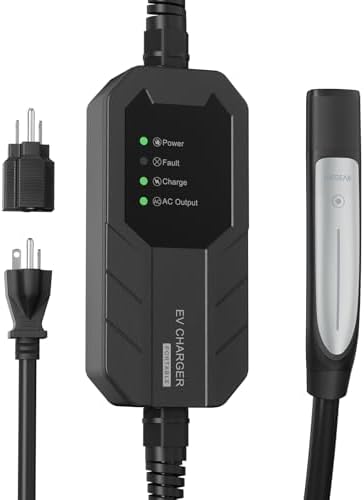

Level 1 and Level 2 Portable EV Charger
$159 price checked August 2026
Read our full Portable EV Charger review
If you drive a non-Tesla vehicle, browse our top-rated J1772 charging units to find the right fit.

What Happens if You Under-Provision or Over-Buy Max Amperage?
Under-provisioning occurs when you select an EV charger with a max amperage lower than your vehicle’s requirements or your home’s capacity. If the amperage is too low, the charging speed will drop significantly, potentially extending a full charge from a few hours to an entire night or longer.
Slow Charging Impact
A low amperage limit restricts the flow of electricity, meaning the vehicle draws less power at any given moment. If your daily mileage requires a fast turnaround, an under-provisioned charger may leave you with insufficient range for the next day’s travel.
Hardware Limitations
Some EV chargers have internal hardware limits that cap the amperage regardless of the circuit’s capacity. If the charger is rated for 32 A, it cannot deliver 40 A even if your electrical panel allows for it, creating a bottleneck in your charging speed.
What Happens if You Over-Buy Max Amperage?
Over-buying occurs when you install a high-amperage charger and a high-capacity circuit that your vehicle or your home’s electrical panel cannot actually support. This results in unnecessary costs for hardware and electrical work that provides no functional benefit to your charging speed.
Electrical Infrastructure Costs
Increasing the max amperage of a circuit often requires larger gauge wiring and more expensive circuit breakers. If you install an 80 A capable system but your vehicle only supports 32 A of input, you pay for heavy-duty infrastructure that remains underutilized.
Selecting the correct plug is vital, so compare different EV connector types to ensure compatibility.
Permit and Labor Costs
Electrical work for high-amperage circuits often requires specific permits and specialized labor. Over-buying amperage means spending more on these mandatory professional installations for capacity that your specific vehicle model cannot draw from the charger.
What is the Common Mistake with Max Amperage?
The most common mistake is assuming that a higher max amperage on the charger automatically equals faster charging for your specific vehicle. Many owners buy the highest amperage charger available without checking the maximum charging rate supported by their car’s onboard charger.
Vehicle Onboard Limits
Every electric vehicle has an internal onboard charger that limits how much current it can accept. If your vehicle’s onboard charger is limited to 32 A, a charger with a 50 A max amperage will still only charge at 32 A. You are paying for extra capacity that the car’s hardware cannot use.
Optimizing for Compatibility
Instead of focusing solely on the highest available amperage, you should optimize for the maximum amperage your specific vehicle can accept. Match the charger’s rating to the vehicle’s peak intake to ensure you are not paying for wasted capacity while still achieving the fastest possible charge time.
How Does Max Amperage Interact with Other Deciding Specs?
Max amperage interacts directly with voltage and the physical connector standard to determine the total power output of the EV charger. A high amperage figure is wasted if the voltage is too low or if the connector standard does not support high-power delivery.
Voltage and Power Relationship
Power is a product of voltage and amperage. In North America, residential charging typically uses 240V. If you need more power but cannot increase the voltage, you must increase the amperage. However, higher amperage requires thicker wires to prevent thermal throttling or overheating.
Connector Standard Limits
The connector standard, such as J1772 or NACS, determines the physical limits of the charging session. Even if a circuit can provide 80 A, the physical pins in a standard J1772 connector may limit the current to prevent melting. You must ensure the connector standard matches the power requirements of your vehicle.
Circuit Breaker Tripping
The max amperage of the charger must always be lower than the rating of the circuit breaker. If a charger attempts to pull more current than the breaker is rated for, the breaker will trip, interrupting the charging session. This occurs when the charger’s demand exceeds the home’s electrical panel capacity.