

Car Forum World is reader-supported: some links on this page are affiliate links, and as an Amazon Associate Car Forum World earns from qualifying purchases at no extra cost to you. Learn more.
Steering cylinders come in three primary types defined by their internal construction and movement mechanics: standard hydraulic rams, heavy-duty industrial actuators, and specialized rack-mount cylinders. The selection depends on the required stroke length and the pressure rating of the hydraulic system. You must measure your required steering angle and the total travel distance of the linkage to determine the necessary stroke length before ordering. A cylinder with a stroke length too short for the required angle will prevent full steering lock, while a cylinder with a stroke length too long will cause mechanical interference with the frame or other components.
Standard Hydraulic Steering Rams for Agricultural and Construction Machinery
Standard hydraulic steering rams are the most common type of steering cylinder used in agricultural and construction machinery. These units are designed to provide linear force to turn wheels or tracks by moving a piston head through a cylinder tube. They are suitable for applications where the steering load is consistent and the movement is predictable. These cylinders typically prioritize a balance between stroke length and bore diameter to ensure the steering remains responsive under load.
If you operate a backhoe, see the best power steering cylinder for Case 580C 580D to find your specific match.
How standard steering rams perform in medium duty tasks
In a standard setup, a buyer identifies the required steering angle and calculates the distance the piston must travel to achieve it. If the linkage geometry allows for a compact installation, a standard ram provides sufficient force for most medium-duty tasks. However, these units may lack the high-duty cycle capabilities of industrial components, meaning they are not intended for continuous, high-frequency movement cycles over many hours of operation. These cylinders generally occupy the lower to mid-range price points in the category.
Operators of older models can find the best power steering cylinder for Ford 600 800 in our detailed roundup.
Where these choices show up in our reviews
Prices across these 3 run from $152.35 to $480; each one has a full review here.
Marine engineers can compare the best power steering actuator for Volvo Penta to ensure system compatibility.

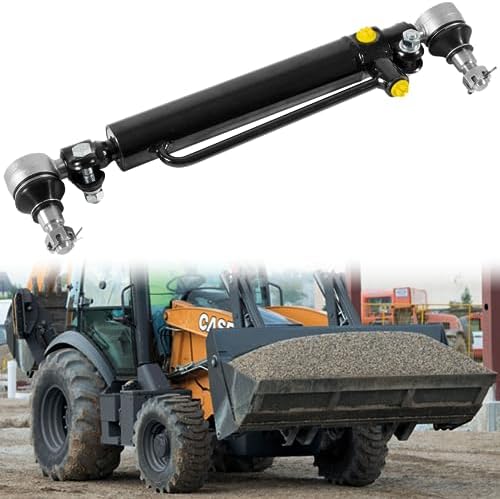

Industrial Grade Actuators for Heavy Duty Machinery Cycles
Industrial grade actuators are high-duty cycle cylinders used in heavy machinery that exceed the specifications of automotive-grade steering rams. These units are engineered to withstand extreme internal pressures and frequent cycling without seal failure or structural fatigue. They are the primary choice for heavy earthmoving equipment or large-scale industrial machinery where the steering force required is massive. Because they are built for heavy-duty cycles, they often feature thicker cylinder walls and reinforced rod ends.
Beginners can learn more about how a steering cylinder works to understand the basic mechanics of hydraulic movement.
Why industrial grade actuators provide durability under extreme stress
The primary advantage of an industrial grade actuator is its durability under extreme stress. These units are designed to maintain consistent cycle speeds even when the hydraulic pump is operating at its maximum output. The trade-off for this durability is a higher cost and a heavier physical footprint, which may make them harder to mount in tight spaces. If your application involves heavy lifting or moving heavy loads over uneven terrain, the industrial grade actuator is the necessary choice to prevent structural failure. These units sit at the highest price point in the category.
If you are considering different designs, explore the alternatives to a steering cylinder to find the right fit.
Rack Mount Steering Cylinders
Rack mount steering cylinders are integrated units where the cylinder is designed to work in tandem with a steering rack or a specific mounting rail. These are often used in applications where space is at a premium and the steering geometry is fixed. Unlike a standalone ram that might be mounted at an angle, these are often oriented to move the linkage along a specific axis. They provide a compact footprint and a stable mounting point for the steering linkage.
Before finalizing your purchase, review common steering cylinder warranties to understand your coverage options.
How specialized mounting orientations affect cylinder installation and pricing
These cylinders are best for setups where the steering geometry is already established and requires a specific mounting orientation. They offer a more streamlined installation in some configurations but may offer less flexibility in terms of mounting angles compared to a standard ram. Because they are often specialized for specific mounting styles, they are priced based on the complexity of the mounting interface. A buyer should confirm the mounting orientation and port positioning before ordering, as incorrect placement prevents the cylinder from aligning with the steering linkage.
You can find a comprehensive data sheet and full Power Steering Cylinder review for the D128454 model.
Comparison of Steering Cylinder Types
| Type | Best-fit Buyer | Main Advantage | Main Compromise |
|---|---|---|---|
| Standard Hydraulic Ram | Medium-duty agricultural use | Balanced stroke and bore | Lower duty cycle limits |
| Industrial Grade Actuator | Heavy earthmoving machinery | High-duty cycle durability | Higher weight and cost |
| Rack Mount Cylinder | Space-constrained applications | Compact mounting footprint | Limited mounting orientation |
Which steering cylinder type do you need?
You need to determine your steering cylinder type by checking the maximum load and the required steering angle of your machine. If your application requires the steering to move heavy loads through high-resistance environments, you should look for a unit with a high bore pressure rating. A cylinder with a lower PSI rating than the pump output causes seal blowout or structural failure. For these high-pressure needs, the industrial grade actuator is the standard choice.
Technical details are available in our SX Power Steering Actuator review for the HOLDWELL ram.
Selecting rack mount cylinders for limited space and stroke length
If you are working within a fixed frame where space is limited, you should check if a rack mount cylinder fits your mounting requirements. You must confirm that the port positioning and mounting eye placement align with your existing steering linkage. If the linkage is straightforward and the weights are moderate, a standard hydraulic ram provides the necessary stroke length and bore diameter. Choosing a cylinder with a stroke length that is too short prevents full steering lock, while one that is too long causes mechanical interference.
For specific fitment details, see our 84-50012AN Ram Assist review to verify the assist cylinder’s performance.
How matching stroke and pressure prevents steering system failure
Selecting the wrong cylinder type can result in a complete rebuild of the steering linkage or a total loss of the hydraulic system due to a seal blowout. A buyer should first measure the required travel distance and then confirm the hydraulic pump’s output pressure. Once these two values are known, you can select the cylinder that matches the required stroke and pressure. If you are unsure of the required pressure, consult the original manufacturer’s specifications to ensure the cylinder can handle the pump’s peak output.
Browse our other steering cylinder pages
- The Power Steering Cylinders That Work Best for John Deere
- Which Power Steering Actuator Is Best for Volvo Penta?
- Best Power Steering Cylinder for 1965-1966 Mustang
- Heavy Duty Steering Cylinders for Case 480B 480C Compared
- Which Power Steering Cylinder Is Best for Case 580C 580D?
- Best Power Steering Cylinder for Ford 600 800