

Car Forum World is reader-supported: some links on this page are affiliate links, and as an Amazon Associate Car Forum World earns from qualifying purchases at no extra cost to you. Learn more.
Stroke length for a steering cylinder is the distance the piston head travels from its fully retracted position to its fully extended position. You must determine this value based on the required steering angle of your specific machinery or vehicle and the physical space available for the cylinder’s movement.
Which Steering Cylinder Stroke Length Suits You?
| If this is you | The Stroke Length that suits you | Why |
|---|---|---|
| Operating a small utility trailer or a compact garden tractor | 4 to 8 inches | Smaller vehicles require a limited range of motion to maintain maneuverability and prevent the cylinder from bottoming out. |
| Equipping a standard agricultural tractor or a medium-duty skid steer | 10 to 18 inches | These machines require a balanced range of motion to provide consistent leverage across a standard steering arc. |
| Fitting a large industrial excavator or heavy-duty construction machinery | 20 to 36 inches | Heavy-duty applications demand long-travel cylinders to achieve the necessary turning radius for large-scale equipment. |
| Replacing a cylinder on a custom-built heavy haulage truck | 36+ inches | Specialized heavy haulage often requires extreme travel lengths to navigate tight turns with oversized loads. |
Steering Cylinders we have reviewed in detail
From $109 to $279: 3 of the 11 in this category we have reviewed in full.

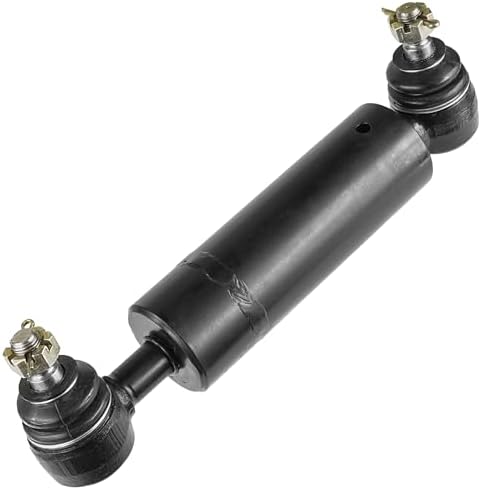

How Do I Measure the Required Steering Cylinder Stroke?
To establish your required stroke length, you must calculate the arc of movement needed to turn your wheels or tracks from one side to the other. Start by identifying the center point of your steering pivot. Measure the distance from this pivot point to the center of your steering mounting point. You then need to determine the maximum angle the wheels can turn before hitting a physical stop or reaching the limit of the machine’s frame.
Calculating required steering cylinder stroke using turn radius and angle
The calculation involves finding the radius of the turn and multiplying it by the sine of the maximum steering angle. For example, if your pivot to mounting point is 20 inches and your maximum steering angle is 30 degrees, the required stroke is approximately 10 inches. Do you have a specific angle in mind? If you know your maximum turn angle is 40 degrees on a 20-inch radius, you will need a 13.7-inch stroke length.
Measuring physical clearance limits for steering cylinder extension
Before ordering, physically measure the available space where the cylinder will sit. Ensure that the cylinder has enough room to extend fully without striking the frame, the wheels, or other mechanical components. Write down the maximum possible extension distance in inches. This physical “clearance” is the absolute upper limit for your stroke length. If your calculated required stroke is 12 inches but your physical clearance is only 10 inches, you must reduce your steering angle or change the mounting position.
Identifying stroke length on manufacturer data sheets and cylinder bodies
Look for the stroke length on the manufacturer’s data sheet or the cylinder body itself. It is usually listed as “Stroke” or “Travel” and is measured in inches. Note that this is different from the “bore” or “rod diameter.” The stroke is only the length of the moving part of the cylinder, not the total length of the metal housing.
What Happens if the Steering Cylinder Stroke Length is Incorrect?
A stroke length that is too short prevents the steering mechanism from reaching its full intended range of motion. This results in a “hard stop” where the wheels cannot turn far enough to complete a turn, potentially causing the vehicle to move in a straight line when a turn is required. This is a significant safety risk in heavy machinery where precise movement is necessary to avoid obstacles.
How a short steering cylinder stroke causes linkage stress
If the stroke is too short, the steering linkage may experience excessive stress as it tries to force the wheels past their physical limit. This can lead to bent tie rods, damaged mounting brackets, or a complete failure of the steering cylinder‘s internal seals. Because the cylinder cannot travel the required distance, the hydraulic pressure will spike rapidly, which can cause the cylinder to vibrate or “kick” under load.
Risks of mechanical interference with an excessively long stroke
Conversely, a stroke length that is too long creates a risk of mechanical interference. If the cylinder extends further than the geometry of the steering linkage allows, the piston head will hit the end of the cylinder’s internal stroke before the wheels reach their limit, or the cylinder itself will physically strike the frame. This creates a situation where the steering feels “mushy” or unresponsive at the end of the turn because the cylinder has run out of travel.
Preventing cylinder buckling by accounting for side-loading and tolerances
In some configurations, an excessively long stroke can cause the cylinder to become unstable or “buckle” if the load is not perfectly centered. Because the rod is longer, it is more susceptible to side-loading. This can lead to the rod bending or the cylinder housing cracking under high-pressure operation. Always ensure the stroke length provides a buffer of at least 1 inch of “free travel” beyond your required turning angle to account for mechanical tolerances.
What Should I Do if My Requirements Fall Between Two Stroke Lengths?
When your calculated requirement falls between two standard stroke lengths, you should prioritize the shorter of the two options, provided it still meets your minimum required turn angle. Choosing the shorter stroke is generally safer because it reduces the risk of the cylinder body hitting the machine’s frame or other components during operation.
Adjusting mounting geometry to accommodate different steering cylinder strokes
If the shorter option does not provide enough travel to reach your required angle, you must choose the longer stroke and adjust your mounting geometry. This involves moving the mounting points of the cylinder further apart or changing the pivot point of the steering linkage. By increasing the distance between the mounting points, you can achieve a greater turn angle with a shorter stroke length, or conversely, allow a longer stroke to cover a wider arc.
Selecting steering cylinder stroke based on available machine clearance
When choosing between a 12-inch and a 14-inch stroke, evaluate the physical clearance of your machine. If you have 15 inches of clear space, the 14-inch stroke is acceptable. If you only have 13 inches of clear space, you must select the 12-inch stroke. It is better to have a slightly smaller steering angle than to have a cylinder that cannot fully extend. A cylinder that hits its internal limit before the wheels reach their stop will cause the steering to feel dead and unresponsive at the end of the movement.
Choosing the most stable mounting position for similar stroke lengths
If the two options are very close, such as a 15-inch and a 16-inch stroke, the difference in steering angle provided is usually negligible. In these cases, select the stroke that allows for the most stable mounting position. A cylinder that is mounted perfectly level and centered on its brackets will provide more consistent steering than one that must be tilted or offset to accommodate a specific stroke length. Proper mounting ensures that the hydraulic force is applied directly through the center of the cylinder, preventing premature wear on the seals and the rod.
Confirming mounting orientation and clearance before ordering a cylinder
Always confirm the mounting orientation before finalizing your choice. The stroke length is only useful if the cylinder can be mounted in a position that allows it to move freely. If a longer stroke requires the cylinder to be mounted in a way that blocks the path of the wheels, the longer stroke is unusable. Measure your clearance twice before placing an order, as custom-sized steering cylinders are often difficult to return once the mounting brackets are fabricated.
The other steering cylinder guides we have published
- Heavy Duty Steering Cylinders for Case 480B 480C Compared
- Which Power Steering Cylinder Is Best for Case 580C 580D?
- Best Power Steering Cylinder for Ford 600 800
- Reliable Power Steering Rams for Chevy Nova Impala Compared
- Choosing the Best Steering Cylinder for Massey Ferguson Tractor
- The Power Steering Cylinders That Work Best for John Deere