Most standard car radiators require a core thickness between 2.0 in. and 3.0 in. depending on the vehicle’s engine size and cooling requirements. You should select a thickness that balances sufficient surface area for heat dissipation with the physical space available in your engine bay.
Recommended Core Thickness by Use Case
| Use Case | Recommended Core Thickness | Why this number |
|---|---|---|
| Economy Commuter | 2.0 in. to 2.5 in. | Standard engines produce manageable heat loads that these dimensions can dissipate efficiently. |
| Mid-Size SUV/Truck | 2.5 in. to 3.0 in. | Larger displacement engines require more surface area to prevent overheating under heavy loads. |
| High-Performance Tuning | 3.0 in. to 4.0 in. | Increased horsepower and high-RPM operation necessitate a thicker core to handle extreme thermal spikes. |
| Heavy Duty Towing | 3.0 in. to 3.5 in. | Constant high-load operation requires a thick core to maintain steady coolant temperatures. |
Products in this category with a full review here
3 reviewed options, $149 to $246, with the full write-up behind each name.

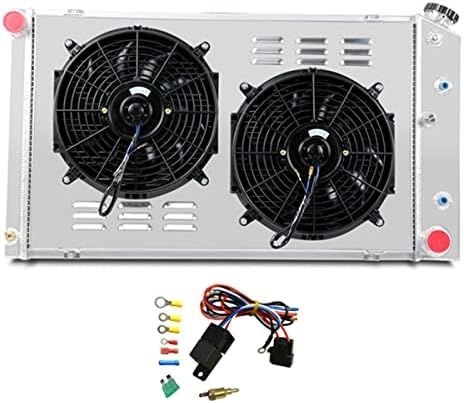
3 Row Aluminum Radiator Kit for Chevy Chevelle
$236 price checked August 2026
Read our full Chevelle Aluminum Radiator review
If you are on a budget, browse affordable Toyota Camry radiator options to find the best value.

What Happens if You Under-Provision or Over-Buy Core Thickness?
Under-provisioning occurs when the core thickness is insufficient to move heat away from the engine coolant. If you choose a radiator with a core too thin for your engine’s output, the coolant will reach its boiling point more quickly, especially during uphill climbs or in heavy traffic. This leads to the cooling fans running at maximum speed constantly, which increases parasitic power loss and puts extra strain on the cooling fan motor.
Thermal Limits of Thin Cores
A thin core has less surface area for the coolant to pass through. When the heat load exceeds what that surface area can shed, the temperature of the coolant rises rapidly. In extreme cases, this leads to localized boiling, which creates steam pockets that block flow and can cause the engine to overheat in seconds.
Over-buying core thickness involves selecting a radiator that is thicker than your engine actually requires. While this might seem like a safety margin, it introduces physical and mechanical constraints. A thicker core takes up more volume in the engine bay, which can interfere with the radiator fan’s ability to pull air through the fins. If the fan cannot clear enough air because the core is too deep, the extra thickness provides no actual cooling benefit.
You should also consider how to select the correct core width to ensure proper airflow.
The Cost of Excess Thickness
The primary cost of over-buying is the loss of airflow efficiency. Because air must travel through the entire depth of the core, a very thick radiator increases the resistance to airflow. If the cooling fan is not powerful enough to overcome this resistance, the core becomes a wall that traps heat rather than a heat exchanger that sheds it. Furthermore, thicker units are heavier, adding unnecessary weight to the front of the vehicle.
What Mistake Do Most Buyers Make with Core Thickness?
Many buyers assume that a thicker core always equals better cooling, leading them to choose the largest radiator that will physically fit in the space. This is a mistake because core thickness is only one half of the cooling equation; the other half is the “fin density” and the “face area” of the radiator.
Optimising for Surface Area Instead
You should focus on the total surface area of the radiator face rather than just the depth of the core. A radiator with a slightly thinner core but a wider face (more inches wide) can often dissipate more heat than a thick, narrow core. This is because a wider face allows for a larger total area of contact between the coolant and the air. If your engine bay has the width available, a wider radiator is often a more effective cooling solution than a deeper one.
Balancing Flow and Resistance
Instead of chasing the highest core thickness number, you should optimize for the balance between core thickness and fin pitch. The goal is to find the point where the core is thick enough to handle the heat but thin enough to allow the cooling fan to push air through it effectively. A 3.0 in. core with a wide face is often a superior choice to a 4.0 in. core that restricts airflow to the point of stagnation.
How Core Thickness Interacts with Other Deciding Specs
Core thickness does not exist in a vacuum; its effectiveness is limited by the radiator’s face area and the fan’s static pressure. A high core thickness figure is wasted if the radiator is too narrow to provide sufficient surface area for the engine’s displacement.
The Face Area Constraint
The total surface area is the primary determinant of heat dissipation. If you have a large engine, you need a large face area. If you choose a thick core but a small face area, you will still experience overheating because there isn’t enough “room” for the heat to escape. In many applications, increasing the width of the radiator provides a much larger cooling gain than increasing the thickness of the core.
The Fan Pressure Limit
The cooling fan is the ultimate limit on how much core thickness you can use. Every radiator has a point of diminishing returns where adding more thickness increases air resistance more than it increases heat dissipation. If the fan’s static pressure cannot push air through a 3.5 in. core, that extra half-inch of thickness provides zero additional cooling. You must ensure that the fan’s CFM (Cubic Feet per Minute) and pressure ratings are compatible with the thickness of the core you select.
Material and Construction Efficiency
The material of the core, such as aluminum versus copper-brass, also affects how much thickness you need. Aluminum radiators typically require a slightly larger surface area to match the heat transfer efficiency of copper-brass. If you are moving to an aluminum unit, you might need to compensate for the material difference by choosing a core thickness at the higher end of the recommended range or by opting for a wider face area.