Most passenger vehicles require a car radiator with a 2-row or 3-row core to maintain stable operating temperatures. You should select the row count based on your engine’s heat output and the specific cooling demands of your driving environment.
Recommended Row Counts for Car Radiators by Use Case
| Use Case | Recommended Row Count | Why this number |
|---|---|---|
| Standard Commuting | 2-Row | Provides sufficient surface area for low-to-moderate heat loads in daily driving. |
| Towing or Heavy Loads | 3-Row | Increased core thickness manages the higher thermal output of a strained engine. |
| Performance Tuning | 3-Row | Higher row counts provide the necessary heat dissipation for high-RPM sustained use. |
| Extreme Climates | 3-Row | Greater surface area helps maintain cooling efficiency in high-ambient-temperature regions. |
| Off-Roading/Slow Speed | 3-Row | Higher density cores compensate for reduced airflow at lower vehicle speeds. |
Products in this category with a full review here
Prices across these 3 run from $149 to $236; each one has a full review here.
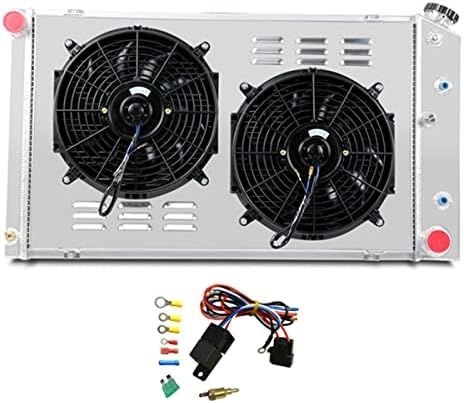
3 Row Aluminum Radiator Kit for Chevy Chevelle
$236 price checked August 2026
Read our full Chevelle Aluminum Radiator review
If you are upgrading a heavy-duty truck, see our top-rated 3 row radiator for ford f250 f350.


DNA Motoring RA-CCV889-3 3-Row Full Aluminum Radiator
Owners of high-performance JDM cars can view our comparison of the best performance radiator for subaru wrx sti.
$152.99 price checked August 2026
What Happens if You Go Under or Over on Row Count?
Going under the required row count for your car radiator leads to inadequate heat dissipation. If the surface area of a 2-row core cannot process the engine’s thermal output, the coolant temperature will rise rapidly during heavy loads or high-speed driving.
This under-provisioning can trigger the engine’s cooling fans to run constantly, which reduces fuel efficiency and increases wear on the fan motor. In severe cases, the coolant may reach boiling point, leading to pressure build-up and potential overheating of the cylinder head.
Understanding row count is only half the battle, so also consider how core thickness affects radiator cooling.
The Real Cost of Over-Buying Row Count
Over-buying row count involves installing a 3-row or higher core when a 2-row unit is sufficient for your needs. While this may seem like a safety buffer, a thicker core creates a physical obstacle for airflow and coolant movement.
A thicker radiator core increases the pressure drop across the unit, meaning the water pump must work harder to push coolant through the extra material. This can lead to reduced flow rates in the cooling system. Additionally, a larger, thicker radiator may not fit within the original engine bay, requiring modifications to the mounting brackets or surrounding components.
The Mistake Most Buyers Make with Row Count
The most common mistake buyers make with row count is assuming that a higher number always equals better cooling regardless of the radiator’s physical dimensions. A 3-row radiator with a small face area can be less effective than a 2-row radiator with a much larger face area.
You should optimize for total surface area rather than just the number of rows. The surface area is a product of the radiator’s width, height, and the depth of the core. A wide, shallow 2-row radiator often provides more cooling capacity than a narrow, deep 3-row radiator because it allows more air to pass through the core simultaneously.
Prioritising Surface Area Over Core Depth
When evaluating your requirements, check the face dimensions of the unit first. If the radiator’s width and height match the OEM (Original Equipment Manufacturer) specifications, the row count should be chosen to meet the heat load. If the face area is smaller than the original, you must increase the row count to compensate for the lost surface area.
Once you have the size right, learn how to choose the correct inlet diameter for radiators.
How Row Count Interacts with Other Deciding Specs
Row count interacts with the material construction and the core’s face area to determine the final cooling capacity. A high row count is wasted if the material has poor thermal conductivity or if the radiator is too narrow to capture enough air.
Material and Heat Transfer Efficiency
The construction material of the car radiator determines how quickly heat moves from the coolant to the fins. Aluminum radiators generally offer faster heat transfer than copper-brass units. If you are using an aluminum radiator, you might achieve the necessary cooling with a lower row count compared to a copper-brass unit of the same size.
Airflow and Core Density
Airflow is the primary limit on how much cooling a radiator can provide. A 3-row radiator creates more resistance to air than a 2-row unit. If the vehicle’s cooling fan cannot provide enough static pressure to push air through a high-density core, the extra rows will not provide additional cooling. In these cases, a 2-row radiator with a larger face area is the more effective choice because it allows for easier air penetration.
Mounting and Fitment Constraints
The physical thickness of a 3-row radiator often limits its compatibility with existing mounting points. Before selecting a higher row count, you must confirm that the mounting rail spacing and bracket holes align with your vehicle’s chassis. A radiator that is too thick may sit too close to the engine block or the front bumper, restricting the very airflow it was intended to manage.