Inlet diameter refers to the internal width of the primary port where coolant enters the car radiator. Your specific vehicle’s engine design and existing cooling system architecture determine which diameter you must match.
Which Inlet Diameter Suits Your Vehicle?
| If this is you | The Inlet Diameter that suits you | Why |
|---|---|---|
| You own a standard passenger car or small SUV. | 1.25 in to 1.5 in | These are the industry standard sizes for most mass-market cooling systems. |
| You are working on a heavy-duty truck or large commercial vehicle. | 1.75 in to 2.0 in | Larger engines require higher flow rates which necessitate wider ports. |
| You are installing a high-performance racing radiator. | 1.5 in to 2.0 in | High-performance builds often use larger diameters to reduce fluid velocity and pressure drop. |
| You are performing a period-correct restoration on a vintage car. | Match the OEM specification | Older vehicles often used non-standard diameters that differ from modern 1.5 in standards. |
Products in this category with a full review here
Prices across these 3 run from $107.78 to $349.26; each one has a full review here.

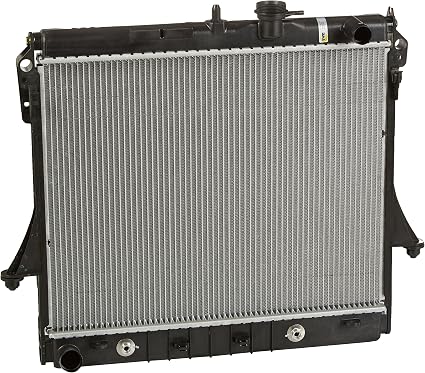
TYC 2855 Replacement Radiator for Hummer
You can also find our comparison of high-performance Subaru WRX STI radiators to see which model leads the pack.
$107.78 price checked August 2026

Primecooling 2 Row Aluminum Radiator Ford F250 F350
$246 price checked August 2026
Read our full Ford F250 Radiator review
Selecting the right flow path is easy once you learn how to select the correct outlet diameter for your cooling system.
How Do I Measure My Current Car Radiator Inlet?
To establish your required inlet diameter, you must measure the internal opening of your current radiator or the diameter of the existing hose connection point.
Tools for Accurate Measurement
Use a digital caliper to get a precise reading in inches. A caliper allows you to measure the internal diameter (ID) of the port without the interference of the outer housing or mounting brackets.
Locating the Measurement Point
Identify the primary inlet—the port where the main upper or lower hose connects to the radiator face. Measure the clear space inside the tube. If the port is obstructed by a flange, measure the diameter of the hose barb that fits into that specific port.
Verifying with OEM Documentation
If the radiator is currently removed, you can find the required diameter in the vehicle’s service manual or by searching for the original equipment manufacturer (OEM) part number. The technical specifications will list the inlet and outlet diameters in inches.
What Happens if the Inlet Diameter is Incorrect?
An incorrect inlet diameter creates a mismatch between the radiator’s flow capacity and the vehicle’s cooling system, leading to specific mechanical issues.
Risks of a Diameter That is Too Small
If the new radiator has an inlet diameter smaller than the original, the system creates a flow restriction. This restriction acts like a bottleneck, forcing the water pump to work harder to push coolant through a narrow opening. This can lead to localized hotspots in the engine block and a decrease in overall cooling efficiency, potentially causing the engine to overheat under heavy loads.
Determining the proper spacing for your engine bay requires knowing how to choose the correct core width for your vehicle.
Risks of a Diameter That is Too Large
A diameter that is significantly larger than the original can lead to issues with hose compatibility and mounting. Because the port is wider, standard hoses may not seat securely or may require specialized adapters. If the connection is not perfectly sealed, it creates a high risk of coolant leaks. Additionally, if the flow is too unrestricted for the pump’s design, it can occasionally lead to reduced pressure within the cooling circuit.
What if My Measurement Falls Between Two Sizes?
If your measurement falls between two standard sizes, such as 1.3 in or 1.4 in, you must choose the size that ensures a secure, leak-proof connection with your existing hoses.
When to Choose the Larger Diameter
If you are between sizes, choosing the slightly larger diameter is often the safer choice for flow, provided you have the correct hose to fill it. A larger port allows for more volume, but you must ensure the hose can be clamped down firmly to prevent spraying.
When to Choose the Smaller Diameter
Choose the smaller diameter if your existing hoses are fixed and cannot be replaced. It is easier to adapt a smaller radiator port to a larger hose using a reducer than it is to find a custom-sized hose for an oversized port. Ensure the reducer is rated for the correct pressure and temperature of your engine’s cooling system.
Using Adapters for Sizing Conflicts
In cases where a perfect match is unavailable, you can use high-quality brass or aluminum adapters. These fittings allow you to bridge the gap between a 1.5 in port and a 1.75 in hose, for example. Always ensure the adapter material is compatible with the radiator’s construction to prevent galvanic corrosion.
Because radiator sizing is critical for vehicle safety, always confirm your measurements with a qualified mechanic before placing an order. Most retailers have specific return policies regarding sizing errors, so verifying your requirements beforehand avoids the need for returns.