Legally required certifications for an electric vehicle charger ensure the device meets basic electrical safety standards for sale and installation in a specific region. Voluntary marks, such as those from independent safety labs or smart-charging networks, provide additional evidence of build quality and interoperability. Decorative marks are often marketing-led logos that indicate a brand’s membership in a trade group rather than a technical validation of the hardware’s safety or performance.
UL Certification and Electrical Safety
UL certification is a safety mark issued by Underwriters Laboratories that verifies a product meets specific safety standards for electrical components and assemblies. For an electric vehicle charger, this mark confirms the unit has been evaluated to prevent hazards like electrical shock, fire, or mechanical failure under normal and foreseeable misuse conditions. UL certification does not guarantee the charger will provide the fastest possible charging speeds or include specific smart features. It is a safety baseline, not a performance rating.
UL and ETL Equivalency
ETL is an equivalent safety mark issued by Intertek that provides the same level of safety assurance as UL. Many EV chargers carry either mark, as both are recognized by electrical inspectors during the permitting process for a home installation. If a charger lacks one of these recognized safety marks, a local electrical inspector may refuse to sign off on the installation.
Where these choices show up in our reviews
From $139.98 to $349: the 3 in this category we have reviewed in full.

PRIMECOM Level 2 Portable EVSE Smart Charger
If you drive a non-Tesla vehicle, view our comparison of top J1772 models.
$349 price checked August 2026
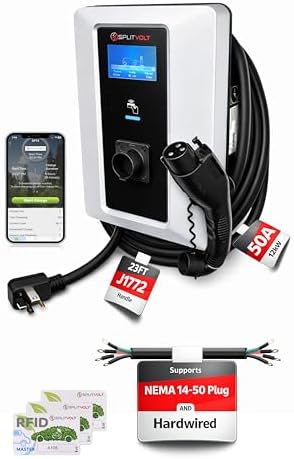
Splitvolt Level 2 Smart EV Charging Station
$310.19 price checked August 2026
For those on a tight budget, see the best budget level 2 home chargers.
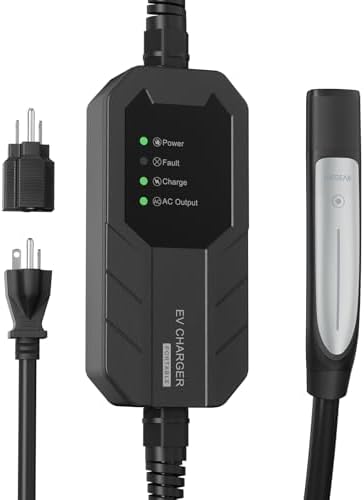
MEGEAR 16 Amps Level 1-2 Tesla Charger
$139.98 price checked August 2026
Understanding your vehicle’s requirements starts with how to choose your connector type.
NEMA Standards and Connector Types
NEMA standards define the physical dimensions and electrical ratings of the connectors and plugs used in North American EV charging. The J1772 standard is the primary format for non-Tesla AC charging, ensuring that the plug fits the vehicle’s port and handles the correct voltage. NEMA standards do not guarantee the internal electronics of the charger are high-quality; they only ensure the physical connection is standardized.
NEMA 14-50 vs NEMA 6-20
A NEMA 14-50 outlet provides a 240V circuit capable of supporting the 40 Amps required for 11.5 kW charging. A NEMA 6-20 outlet is a 120V circuit and is insufficient for Level 2 charging of most passenger EVs. Understanding these standards ensures you do not purchase a charger that requires a circuit your home’s electrical panel cannot provide.
Safety Failure Modes and Protective Standards
Safety failure modes in EV charging primarily involve thermal issues and circuit overloads. The UL and ETL standards address these by requiring the charger to have internal protections against over-current and over-temperature. These standards ensure that if a component begins to overheat, the unit will shut down before a fire occurs.
Determining your power needs is easier when you calculate the max amperage required.
Thermal Throttling and Cable Safety
Thermal throttling occurs when a cable or connector becomes too hot, causing the charger to reduce the power output to prevent melting. While safety certifications ensure the hardware won’t catch fire, they do not always guarantee the charger will maintain maximum output during long charging sessions in high-ambient temperatures. This is a limitation of the hardware’s cooling design rather than a failure of the safety certification.
Circuit Breaker Tripping
Circuit breaker tripping happens when the charger’s demand exceeds the home’s electrical capacity, such as trying to pull 40 Amps from a 30 Amp breaker. Safety standards ensure the charger will trip the breaker safely, but they do not prevent the trip itself. You must ensure your home’s electrical infrastructure matches the charger’s maximum output rating.
How to Verify a Safety Mark is Real?
Verifying a safety mark ensures that the certification is valid and not just a printed logo on a box. Because counterfeit labels can exist, use these checks to confirm the legitimacy of the certification:
- Check the manufacturer’s website for a publicly listed UL or ETL file number.
- Verify the file number on the official UL Product iQ or Intertek websites.
- Look for a physical holographic sticker or embossed mark on the charger housing.
- Confirm the certification covers the specific model and voltage rating of the unit.
Which Marks are Non-Negotiable?
UL or ETL certification is a non-negotiable requirement for any electric vehicle charger intended for permanent home installation. These marks are the primary requirement for passing a local electrical inspection and ensuring the device meets basic fire and shock safety standards. While smart features, app integration, and load balancing are valuable for user experience, they are secondary to the fundamental safety certifications required to protect the home’s electrical system.