There are three primary types of wheel bearings defined by their physical design and how they seat into the vehicle’s hub assembly. The main distinction that changes a buying decision is whether the bearing is a standalone component or part of a complete hub unit. This choice determines whether a repair requires pressing individual bearings into a hub or replacing the entire mounting assembly.
What are Wheel Hub Assemblies?
Wheel hub assemblies are complete units that combine the wheel bearing, the hub, and often the studs or bolts into a single component. These are designed for vehicles where the hub and bearing are integrated, meaning the bearing is not a separate part that can be pressed into a housing. If your vehicle uses a hub assembly, you replace the entire unit rather than the internal bearings.
The hub assembly is for owners who prioritize a faster, more straightforward installation process over the lower part cost of individual bearings. Because the unit comes pre-assembled, it eliminates the need for specialized heavy machinery like a hydraulic press to seat the bearings. This type provides a more consistent fit because the manufacturer ensures the bearing and hub are perfectly aligned before they reach the shop.
The compromise of a hub assembly is the higher price point relative to individual bearings. You are paying for the manufacturing of the hub itself, even if the hub is still functional. However, because these are the standard for most modern passenger cars and SUVs, they are the most common choice for general repairs.
Where these choices show up in our reviews
Prices across these 3 run from $174.95 to $229.80; each one has a full review here.
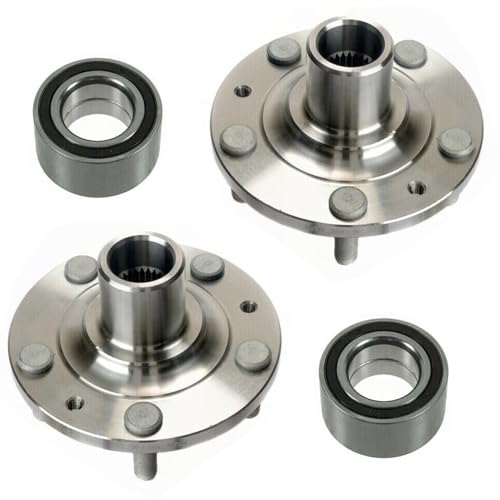
Detroit Axle Front Wheel Bearing and Hub Assembly
$229.80 price checked August 2026
Read our full Front Wheel Bearing review
For a deeper dive into the mechanics, learn how a wheel bearing works and functions.


What are Press-Fit Wheel Bearings?
Press-fit wheel bearings are standalone components that must be forced into a hub housing using a hydraulic press or a heavy-duty mounting tool. These are used in applications where the hub and the bearing are separate pieces, such as on many heavy-duty trucks, older vehicles, and some performance cars. This type is defined by its requirement for a specific installation environment.
You can also find common wheel bearing terms and specs explained to help with your search.
Press-fit bearings are for those seeking the lowest possible part cost or for specific vehicles that require individual bearing replacement. This option allows for the replacement of only the worn internal component while keeping the existing hub. It provides a way to maintain a vehicle with fewer parts, which can be beneficial for high-mileage fleet maintenance.
The trade-off for a press-fit bearing is the requirement for specialized equipment and the risk of hub damage during the installation process. If the hub housing is not perfectly machined or if the press is misaligned, the bearing may not seat correctly, leading to a hub bore mismatch. This type sits at a lower price point than a full hub assembly but requires more labor and equipment to install.
What are Tapered Wheel Bearings?
Tapered wheel bearings consist of a pair of bearings—one inner and one outer—designed to handle both radial and axial loads. These are commonly found on heavy-duty trucks, trailers, and some older automotive applications where the wheel needs to handle significant side-to-side forces. They are distinguished by their conical shape and the need for precise shimming to set the correct end play.
Tapered bearings are for heavy-duty applications where the load requirements exceed what a standard ball or roller bearing can handle. They excel at distributing weight across a larger surface area, which improves longevity under extreme stress. This type is the standard for commercial transport and heavy machinery.
The compromise of a tapered bearing is the complexity of the installation. Unlike a hub assembly which is “bolt-on,” tapered bearings require the installer to set the correct preload using shims. If the shims are incorrect, the wheel can develop wobble or the bearing can overheat. This type sits in a mid-to-high price range depending on the load rating required.
Wheel Bearing Type Comparison
| Bearing Type | Best-Fit Buyer | Main Advantage | Main Compromise |
|---|---|---|---|
| Hub Assembly | Modern passenger car owners | Simplified, bolt-on installation | Higher part cost |
| Press-Fit Bearing | Fleet owners or older vehicle owners | Lower part cost | Requires hydraulic press |
| Tapered Bearing | Heavy-duty truck and trailer owners | High load and axial capacity | Complex shim adjustment |
How to Choose the Right Wheel Bearing Type?
To determine which wheel bearing type you need, you must first identify the mounting style of your vehicle’s hub. Check if the hub and bearing are a single unit or two separate pieces. If the hub is a single unit that bolts to the steering knuckle or axle, you require a wheel hub assembly.
Next, check the load requirements of your vehicle. If you are operating a heavy-duty truck or a trailer that experiences significant side-loading, you likely need a tapered wheel bearing setup. These are identified by a pair of conical bearings rather than a single unit or a single press-fit seat.
Finally, consider your available tools. If you do not have access to a hydraulic press, a press-fit bearing is not a viable option for your repair. In this case, you must either source a hub assembly or a tapered bearing set that matches your vehicle’s specific bolt pattern and bore size.
Browse our other Wheel Bearing pages
- Choosing the Best Front Wheel Bearing Hub Assembly for Ford Fusion
- The Front Wheel Bearing Hub Assemblies That Work Best for Ford Explorer
- Which Wheel Bearing Hub Kits Are Best for Mercury Mountaineer?
- Best Wheel Bearing Hub Assemblies for Toyota 4Runner
- Lexus GX460 Wheel Bearing Hub Assemblies Compared