When researching wheel bearings, most technical specifications relate to load capacity, metallurgy, and geometric tolerances. You can ignore marketing adjectives like “ultra-smooth” or “high-performance” which lack measurable standards. Instead, focus on the material grade, the specific bearing type (such as tapered or ball), and the hub bore dimensions. These data points determine whether the component will survive the mechanical stresses of a vehicle and whether it will physically fit the axle.
Wheel Bearing Capability and Load Specifications
- Dynamic Load Rating – This measures the constant load a bearing can handle while in motion. A higher numerical value indicates a greater capacity to withstand the weight of the vehicle and road impacts during driving.
- Static Load Rating – This represents the maximum load a bearing can withstand when the vehicle is stationary, such as when parked on a slope. Higher ratings provide a greater safety margin against deformation under heavy weight.
- L10 Life – This is a calculated rating representing the number of hours a bearing can operate under a specific load before a 90% probability of failure. A higher L10 life suggests longer longevity and better durability for high-mileage use.
- Heat Treatment – This refers to the thermal processing used to harden the steel. Look for specific standards like “case-hardened” or “induction hardened,” as these processes ensure the bearing surface resists pitting and wear.
- Metallurgy – This identifies the specific steel grade used, such as 52100 chrome steel. Higher-grade steels offer better fatigue resistance and are the standard for OE (Original Equipment) components.
Where these choices show up in our reviews
These 3 have their own full review on this site, and run from $174.95 to $229.80.

TRQ Front Wheel Bearing Hub Assembly Pair
$174.95 price checked August 2026
Read our full Wheel Bearing Hub review
You can also identify the different types of wheel bearings to see which configuration fits your specific vehicle needs.

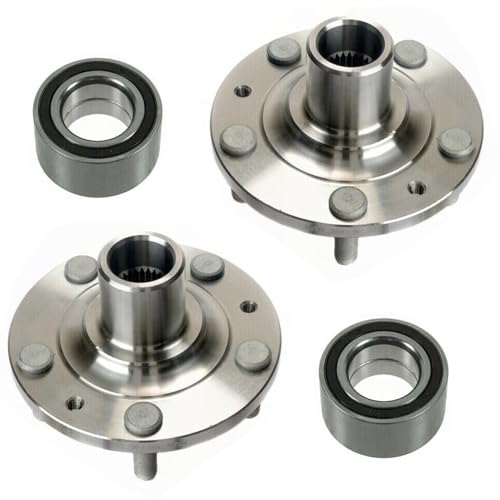
Detroit Axle Front Wheel Bearing and Hub Assembly
$229.80 price checked August 2026
For a foundational understanding, learn how a wheel bearing works to see its role in your vehicle’s drivetrain.
Wheel Bearing Physical and Geometric Terms
- Hub Bore Diameter – This is the internal diameter of the bearing where the axle sits. You must match this measurement exactly to your vehicle’s hub; even a 1mm difference will prevent installation.
- Inner Diameter (ID) – The measurement of the hole in the center of the bearing. This must correspond precisely to the diameter of the axle or spindle.
- Outer Diameter (OD) – The measurement of the exterior of the bearing. This must fit into the hub housing or knuckle without being too tight to press in or too loose to stay seated.
- Width (W) – The thickness of the bearing. If the width is too wide, it will not fit in the housing; if it is too narrow, it will lack the necessary surface area to distribute loads.
- Tapered vs. Ball Bearing – Tapered bearings are designed to handle both radial and axial loads (common in heavy trucks), while ball bearings primarily handle radial loads. Choose the type specified by your vehicle’s manufacturer.
- Press-Fit vs. Bolt-On – Press-fit bearings are secured by friction and must be installed with a hydraulic press. Bolt-on bearings use a flange and bolts to secure the unit to the hub.
Wheel Bearing Compatibility and Fitment
- Hub Assembly – This is a complete unit that includes the bearing, the hub, and the studs. Buying an assembly replaces the entire component, whereas a “bearing only” option requires you to press the new bearing into your existing hub.
- Bolt Pattern – This refers to the spacing of the studs on the hub. If you are replacing a hub assembly, the bolt pattern must match your vehicle’s wheel studs exactly to ensure the wheel aligns correctly.
- Press Fit Tolerance** – This is the allowable clearance between the bearing and the housing. Correct tolerances ensure the bearing stays put under load without seizing or wobbling.
- Axle Alignment – This refers to the orientation of the bearing relative to the axle. Incorrect alignment leads to “pre-loading” issues where the bearing feels tight or binds during rotation.
- Seal Type – This describes the material (such as rubber or metal) used to keep grease in and contaminants out. Standard rubber seals are common, while metal seals are often used in heavy-duty applications for better heat resistance.
Common Wheel Bearing Confusions
Buyers often confuse Hub Assembly with Bearing Only. A hub assembly includes the metal hub, the bearings, and the studs, whereas a bearing only purchase provides just the internal rolling elements. If your hub is cracked or the studs are stripped, you need an assembly; if only the bearing is making noise, you can use the bearing only option.
Another common confusion is between Dynamic Load and Static Load. Dynamic load is what the bearing feels while you are driving, while static load is what it feels when the car is parked. While both are important, the dynamic load rating is the primary indicator of how well the bearing will handle the constant movement and vibration of the road.
Finally, Inner Diameter and Hub Bore are often used interchangeably in some listings, but they refer to different parts of the installation. The inner diameter is the hole in the bearing itself, while the hub bore is the hole in the vehicle’s hub. You must ensure the inner diameter of the bearing matches the hub bore of your vehicle exactly.
Browse our other Wheel Bearing pages
- Best Wheel Bearing Hub Assemblies for Toyota 4Runner
- Lexus GX460 Wheel Bearing Hub Assemblies Compared
- Choosing the Best Front Wheel Bearing Hub Assembly for Ford Fusion
- The Front Wheel Bearing Hub Assemblies That Work Best for Ford Explorer
- Which Wheel Bearing Hub Kits Are Best for Mercury Mountaineer?