Hub Assembly vs. Bearing Only refers to whether you replace just the internal rolling elements or the entire mounting unit including the hub and studs. Your choice depends on the current condition of your vehicle’s hub, the specific mounting requirements of your wheel, and your available tools.
Which Hub Assembly vs. Bearing Only Option Suits You?
| If this is you | The Hub Assembly vs. Bearing Only that suits you | Why |
|---|---|---|
| You have a rusted, pitted, or cracked hub face. | Hub Assembly | Replacing the hub ensures a clean mounting surface for the wheel and prevents the new bearings from being compromised by existing corrosion. |
| You need to change the wheel stud pattern or bolt circle. | Hub Assembly | The hub assembly provides the correct bolt pattern and stud holes, whereas a bearing-only kit requires the existing hub to be compatible. |
| The hub and studs are in good condition and match your current wheels. | Bearing Only | Replacing only the bearings is a direct repair that maintains the existing hub hardware while restoring rotational movement. |
| You are performing a complete front-end rebuild on a high-mileage vehicle. | Hub Assembly | A full assembly replaces the entire component, ensuring all parts meet the same production standards and wear levels. |
| You are working on a vehicle with a press-fit hub design. | Bearing Only | If the hub is designed to be reused and the bearings are the only failing component, a bearing-only kit is the standard repair. |
Wheel Bearings we have reviewed in detail
These 3 have their own full review on this site, and run from $174.95 to $229.80.


Detroit Axle Front Wheel Bearing Hubs Kit
$182.70 price checked August 2026
Read our full Wheel Bearing Hubs review
If you own this specific SUV, see our top-rated Toyota 4Runner hub assembly guide for the best options.
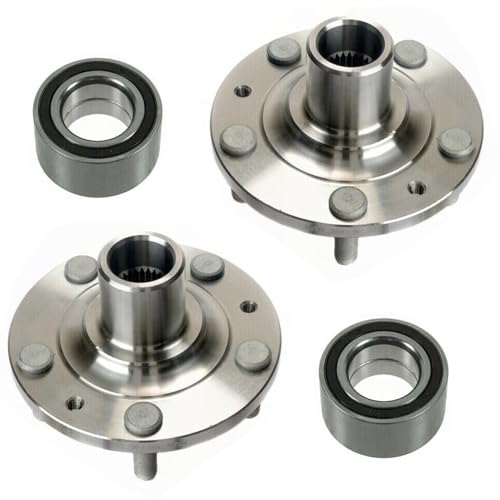
How to Measure and Check Your Hub and Bearing Requirements
Before ordering, you must confirm whether your vehicle requires a Hub Assembly or a Bearing Only kit by identifying the condition of the hub and the mounting hardware.
Checking the Hub Surface and Studs
Inspect the hub face where the wheel bolts on. Look for deep pitting, heavy rust, or cracks in the metal. If the surface is uneven or the metal is flaking away, a Hub Assembly is necessary because a Bearing Only kit cannot fix a compromised mounting surface.
Verifying the Bolt Pattern and Stud Count
Check the number of studs and the distance between the holes (the bolt pattern). If your current hub does not match the wheels you intend to use, you must select a Hub Assembly that matches your specific vehicle’s bolt pattern. A Bearing Only kit will not change the hole positions on the hub.
For a deeper dive into the mechanics, explore how wheel bearings function and operate to understand their role.
Identifying the Bearing Type
Determine if your vehicle uses a press-fit bearing or a bolt-on bearing. You can find this by removing the old bearing or consulting the vehicle’s service manual. A Bearing Only kit must match this specific installation method; a press-fit bearing requires a hydraulic press, while a bolt-on bearing uses a wrench.
What Goes Wrong with the Wrong Hub Assembly vs. Bearing Only Choice?
Choosing the incorrect option leads to mechanical failures that manifest as noise, vibration, or inability to mount the wheel.
Risks of Choosing Bearing Only on a Damaged Hub
If you install a Bearing Only kit onto a hub with surface pitting or cracks, the wheel may not sit flush against the hub. This creates a “wobble” during rotation, which leads to premature wear on the new bearings and potential vibration through the steering wheel. In severe cases, a cracked hub can fail entirely under the load of the vehicle.
Risks of Choosing Hub Assembly with Incorrect Specs
Selecting a Hub Assembly with the wrong bolt pattern or stud count means the wheel will not align with the studs. This makes it impossible to mount the wheel to the vehicle. If the hub is forced into place or the studs are mismatched, it can lead to a catastrophic failure of the mounting hardware while driving.
What to do if You Fall Between Hub Assembly and Bearing Only?
When the condition of the hub is borderline—such as light surface rust or minor pitting—you must decide between a simple bearing replacement and a full hub swap.
The Decision Rule for Borderline Hub Condition
If the hub surface is only slightly rough but the metal is structurally sound and the studs are straight, a Bearing Only kit is usually sufficient. However, if you cannot clean the surface to a smooth finish with a wire brush or if the rust is deep enough to feel with a fingernail, you should move to a Hub Assembly. When in doubt, the Hub Assembly provides a fresh start with a known-good mounting surface.
Final Compatibility Confirmation
If you are unsure about the specific requirements, confirm the hub’s manufacturing standard. Many aftermarket Hub Assemblies are designed to match OE (Original Equipment) standards. If your vehicle uses a specific hub design that is not standard, ensure the Hub Assembly you select is explicitly listed for your vehicle’s year, make, and model to avoid bolt pattern mismatches.
The other Wheel Bearing guides we have published
- Choosing the Best Front Wheel Bearing Hub Assembly for Ford Fusion
- The Front Wheel Bearing Hub Assemblies That Work Best for Ford Explorer
- Which Wheel Bearing Hub Kits Are Best for Mercury Mountaineer?
- Best Wheel Bearing Hub Assemblies for Toyota 4Runner
- Lexus GX460 Wheel Bearing Hub Assemblies Compared