A clutch flywheel is a heavy metal disc attached to the engine’s crankshaft that serves as the primary connection point between the engine’s power and the vehicle’s transmission. It acts as a flywheel by using its mass to maintain rotational inertia, ensuring the engine continues to spin smoothly between power strokes. Simultaneously, it serves as the mounting surface for the clutch assembly, allowing the driver to engage or disengage the engine’s output to the wheels.
The primary problem a clutch flywheel solves is the discrepancy between engine speed and vehicle speed. An internal combustion engine produces power by rotating at high speeds, but a vehicle needs to start from a standstill and change speeds frequently. Without a flywheel to stabilize the engine’s rotation and a clutch surface to manage the engagement of that rotation, the vehicle would jerk violently or stall every time the driver attempted to move or change gears.
How does a clutch flywheel work?
The clutch flywheel works by converting reciprocating piston energy into rotational momentum and providing a friction surface for power transfer. The process follows these steps:
- The engine’s pistons move up and down, turning the crankshaft.
- The flywheel, bolted to the crankshaft, rotates with the engine. Its weight provides the momentum needed to keep the crankshaft spinning even when the engine is not under load.
- When the driver presses the clutch pedal, the pressure plate pulls the clutch disc away from the flywheel surface, breaking the connection.
- When the driver releases the pedal, the pressure plate clamps the clutch disc against the flywheel.
- Friction between the disc and the flywheel allows the engine’s rotation to move the transmission and wheels.
Clutch Flywheels we have reviewed in detail
Prices across these 3 run from $219 to $493.88; each one has a full review here.


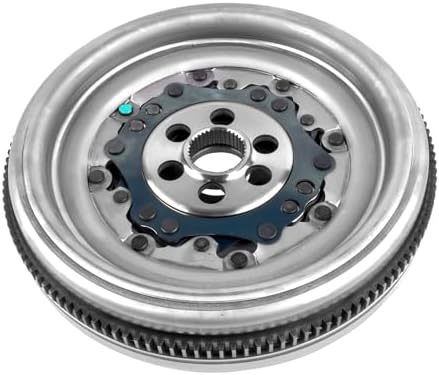
Schaeffler LuK DMF062 Dual Mass Flywheel
Owners of certain German hatchbacks can find the best dual mass flywheel for vw jetta golf beetle to ensure smooth power delivery.
$226.29 price checked August 2026
Parts and stages that matter to a buyer
Several specific technical components determine how a flywheel performs and how long it lasts under different driving conditions.
If you are confused by technical jargon, view our guide to clutch flywheel terms and specs for a clearer understanding.
Dual Mass vs. Solid Flywheels
The flywheel type is the most significant choice for a buyer. A Solid Flywheel is a single, heavy piece of metal. It offers high durability and is common in heavy-duty applications because it can withstand extreme torque. However, it transmits more engine vibration to the cabin. A Dual Mass Flywheel (DMF) consists of two plates connected by springs. The DMF absorbs engine vibrations and harmonics before they reach the transmission, providing a smoother ride in modern passenger cars. Because the DMF has moving internal parts, it is generally more complex and has a shorter service life than a solid version.
Spline count and hub diameter
The spline count refers to the number of teeth on the inner diameter of the flywheel. This must match the transmission’s input shaft exactly. A spline mismatch occurs if the tooth count is incorrect, which prevents the transmission from sliding onto the flywheel or causes the teeth to shear under load. Buyers must confirm the specific hub diameter and spline count for their engine and transmission combination to ensure a proper fit.
Friction surface and heat dissipation
The friction surface is the area where the clutch disc makes contact. This surface must be able to dissipate heat rapidly. If the material cannot handle the heat generated during heavy acceleration, the surface can glaze—a process where the metal becomes smooth and glassy—leading to a loss of grip. High-quality flywheels use specific steel alloys or coatings to ensure the friction surface remains consistent over thousands of engagement cycles.
What does a clutch flywheel change in practice?
The choice of flywheel changes the physical feel of the vehicle and the longevity of the drivetrain. A solid flywheel provides a more mechanical, connected feel and can handle high-torque scenarios without the risk of internal spring failure. In practice, this means the vehicle might vibrate more at idle, but the flywheel itself is less likely to fail prematurely. A Dual Mass Flywheel produces a much smoother experience, especially in stop-and-go city traffic, by dampening the “thrum” of the engine.
The difference becomes most apparent during hard acceleration or heavy towing. A solid flywheel is often preferred for heavy-duty use because it lacks the internal springs of a DMF that can wear out or break. Conversely, in a daily commuter car, the DMF’s ability to reduce harmonic vibration makes the cabin quieter and the gear shifts smoother. In situations where the vehicle is not under heavy load, such as steady highway cruising, the difference between the two types is less noticeable.
Who needs a clutch flywheel?
A clutch flywheel is required for any vehicle equipped with a manual transmission or a dual-clutch transmission (DCT) that utilizes a friction-based engagement system. If the vehicle uses a torque converter (common in most automatic transmissions), a flywheel is still present, but it does not serve as the primary friction surface for the clutch.
Owners of modern front-wheel-drive passenger cars often require a Dual Mass Flywheel to maintain cabin comfort and smooth shifting. Drivers of heavy-duty trucks, performance cars with high-torque engines, or vehicles intended for heavy towing often require a solid flywheel to ensure the component can withstand the mechanical stress of high-torque output. Anyone experiencing “drivetrain shudder,” “clutch slip,” or “rough idling” may need to evaluate the condition of their current flywheel or consider a different flywheel type during a replacement.