Communication protocol refers to the specific wireless language and frequency a tire pressure sensor uses to send data to a vehicle’s onboard computer. Your specific vehicle’s manufacturing requirements determine which protocol you must use to ensure the system recognizes the sensor and displays accurate readings.
Which Communication Protocol suits your situation?
| If this is you | The Communication Protocol that suits you | Why |
|---|---|---|
| You own an older vehicle (typically pre-2010s) with standard radio-based monitoring. | 315MHz or 433MHz | These are the standard radio frequencies for traditional tire pressure monitoring systems. |
| You own a newer vehicle or a Tesla model. | BLE (Bluetooth Low Energy) | Modern manufacturers often use BLE to manage sensor data and battery life more efficiently. |
| You are a professional technician seeking a universal replacement. | Programmable / Cloneable RF | These sensors can be synced to various proprietary IDs used by different manufacturers. |
| You are replacing a sensor in a high-end European vehicle. | Proprietary Encoded RF | Some manufacturers use specific sub-frequencies or unique encryption that requires a specific match. |
Where these choices show up in our reviews
3 reviewed options, $109 to $127.96, with the full write-up behind each name.
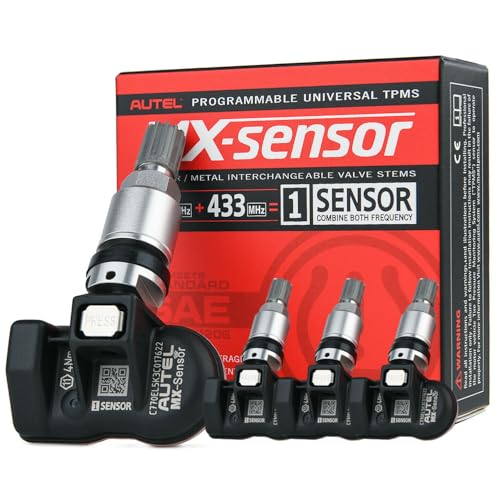
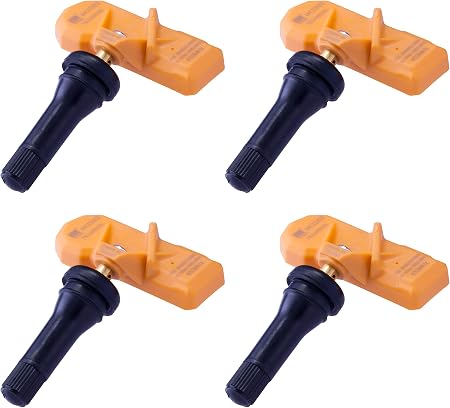
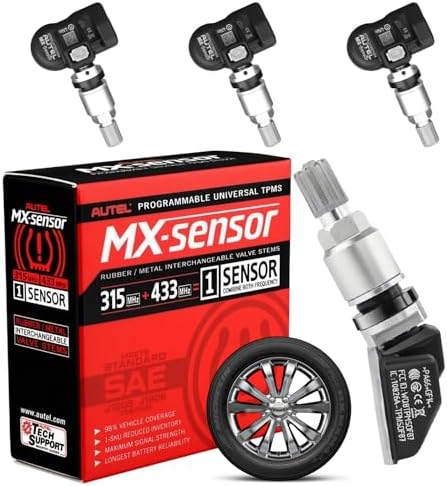
Autel MX TPMS Metal Stem Sensor
$109 price checked August 2026
Read our full Autel MX Sensor review
Understanding the signal range is key, so learn about the proper operating frequency for tire pressure sensors.
How do I find my vehicle’s required Communication Protocol?
You must identify your vehicle’s specific frequency and protocol before ordering a tire pressure sensor to ensure compatibility.
The most reliable way to establish your value is to check the original equipment (OE) sensor currently installed in your vehicle. If your vehicle has a functioning sensor, a technician can use a diagnostic tool to read the frequency and protocol ID. This is the safest method because it eliminates guesswork regarding proprietary encodings.
If you do not have a functional sensor, you can locate the required protocol through your vehicle’s service manual or by contacting a dealership. Look for the “TPMS Frequency” or “Communication Standard” in the technical specifications of your vehicle’s tire pressure monitoring system. The value is usually listed as a numerical frequency (like 315MHz) or a standard name (like BLE).
You can also identify the protocol by the manufacturer. For example, many vehicles in the North American market default to 315MHz, while many European and Asian models utilize 433MHz. However, because of proprietary encoding, the frequency alone is not always enough; the protocol must also match the vehicle’s internal logic.
What happens if I choose the wrong Communication Protocol?
Choosing the wrong Communication Protocol results in a total failure of the tire pressure monitoring system to recognize the new hardware.
Frequency Mismatch Errors
If you install a 315MHz sensor into a vehicle designed for 433MHz, the vehicle’s receiver will be tuned to the wrong “channel.” In this scenario, the dashboard will not show any pressure readings, and the system will likely display a “sensor not found” or “sensor error” message. The hardware is physically correct, but the radio waves are on a frequency the car cannot hear.
Protocol Incompatibility Issues
A more complex failure occurs when the frequency matches but the protocol does not. Some manufacturers use proprietary “languages” or encryption on the standard 433MHz frequency. If the sensor speaks a different language, the vehicle’s computer will receive the signal but will be unable to decode the data. This results in the same “sensor not found” state even though the frequency is correct.
Programming Lockout
Some systems require a specific “handshake” or ID sync. If you choose a sensor that is not “programmable” or “cloneable,” it will remain locked to its original factory ID. The vehicle will reject the sensor because it does not recognize the ID as belonging to that specific car, preventing any data from appearing on the display.
What should I do if my vehicle falls between two protocols?
When a vehicle’s requirements are ambiguous or seem to sit between two standards, you must prioritize the specific manufacturer’s encoding over the general frequency.
If your research suggests your vehicle could use either 315MHz or 433MHz, it is usually because the manufacturer has a specific, non-standard implementation of one of those frequencies. In these borderline cases, you should not guess. The safest path is to identify the specific manufacturer of the tire pressure monitoring system. If the system is produced by a major tier-1 supplier, their specific part number will dictate the exact protocol required.
If you cannot find a definitive answer and the vehicle is a common model, look for sensors that are explicitly listed as compatible with your specific vehicle year, make, and model. Compatibility lists provided by reputable parts suppliers are often based on the specific encoding rather than just the raw frequency. If a sensor is listed as “universal” but does not mention your specific vehicle’s manufacturer, it may lack the necessary programming capabilities to work in a borderline case.
When in doubt, consult a professional technician who has access to the Autel MX-Sensor or similar industry-standard tools. These tools can often identify the exact protocol required by the vehicle’s computer, ensuring you purchase a sensor that is guaranteed to sync with your specific hardware.