Operating Frequency in tire pressure sensors is the specific radio frequency, measured in MHz, used to transmit data between the sensor and the vehicle’s receiver. The correct frequency depends entirely on the vehicle manufacturer’s hardware requirements rather than a universal standard.
Which Operating Frequency fits your vehicle?
| If this is you | The Operating Frequency that suits you | Why |
|---|---|---|
| You own a vehicle manufactured in North America or parts of Asia | 315 MHz | This is a common standard for many regional vehicle brands. |
| You own a vehicle manufactured in Europe or parts of Asia | 433 MHz | This frequency is the standard for most European automotive systems. |
| You own a newer Tesla model | BLE (Bluetooth Low Energy) | Tesla uses BLE protocols instead of traditional RF frequencies for TPMS. |
| You are a technician replacing sensors for a specific fleet | The frequency of the OE (Original Equipment) sensors | Matching the factory frequency ensures the vehicle’s computer can decode the signal. |
Tire Pressure Sensors covered by our own reviews
From $109.99 to $127.96: the 3 in this category we have reviewed in full.
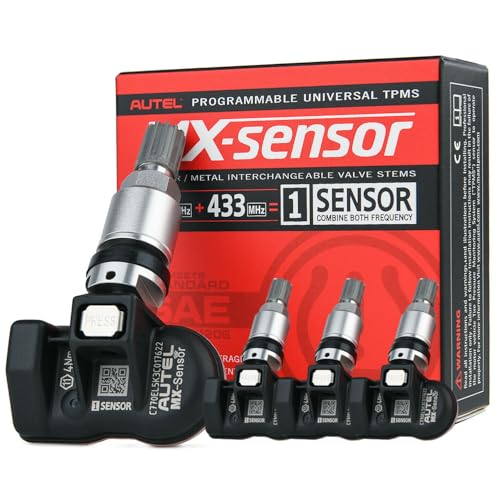
Autel MaxiTPMS 315MHz/433MHz 2 in 1 with MX-Sensor
$127.96 price checked August 2026
Read our full Autel MaxiTPMS review
Once you select a frequency, learn how to choose the correct communication protocol for your specific vehicle.
How do I find my vehicle’s required Operating Frequency?
To find your required Operating Frequency, you must identify the frequency of the sensors currently installed in your vehicle or the requirements of the vehicle’s Tire Pressure Monitoring System (TPMS).
Identify the frequency of existing sensors
If your vehicle already has a functioning TPMS system, the most direct way to find the frequency is to identify the model of the original equipment (OE) sensors. You can find the part number stamped on the sensor itself or listed in the vehicle’s technical specifications.
Consult the vehicle’s technical specifications
The Operating Frequency is often listed in the vehicle’s owner’s manual or the technical data sheet provided by the manufacturer. Look for sections regarding “Tire Pressure Monitoring” or “Electronic Systems” to find the specific MHz value.
Determining your needs is easier when you evaluate the required programming capacity for your tire pressure sensors.
Consult a professional technician
Professional technicians often use specialized diagnostic tools to read the frequency of the vehicle’s internal receiver. If you cannot find the information in the manual, a technician can verify whether the system operates on 315 MHz, 433 MHz, or a proprietary protocol like BLE.
What happens if I choose the wrong Operating Frequency?
Choosing the wrong Operating Frequency results in a total failure of the system to communicate, as the receiver will be listening on a different radio band than the sensor is broadcasting on.
The “Sensor Not Found” error
If you install a 315 MHz sensor into a vehicle designed for 433 MHz, the vehicle’s computer will not detect the new hardware. This results in a “sensor not found” error or a persistent warning light on the dashboard, as the two frequencies cannot interact.
The protocol mismatch issue
Even if you select the correct MHz frequency, a sensor may still fail if the encoding protocol is incompatible. Some manufacturers use proprietary encryption that prevents the vehicle from decoding the data, even if the radio frequency is correct. This is why matching the specific vehicle’s requirements is necessary before ordering.
What do I do if my vehicle uses a non-standard frequency?
If your vehicle falls between standard frequencies or uses a specialized protocol, you must confirm the specific hardware requirements before purchasing any replacement sensors.
Handling BLE and non-RF systems
For vehicles like newer Tesla models that use BLE instead of traditional RF frequencies, standard 315 MHz or 433 MHz sensors will not work. In these cases, you must source sensors specifically designed to communicate via the Bluetooth Low Energy protocol.
Confirming requirements before ordering
Because there is no “best” frequency, you must verify your specific requirements before completing a purchase. If you are unsure of your vehicle’s frequency, check the manufacturer’s part number for your current sensors. Because many systems are not returnable once installed, confirming this data point is the only way to ensure the hardware will function.