When evaluating tire pressure sensors, most marketing copy focuses on “real-time alerts” or “advanced monitoring,” which are standard features for any functioning unit. To make an informed decision, you should ignore these marketing adjectives and focus on the load-bearing technical specifications: frequency, communication protocol, and sensor type. These technical data points determine whether a sensor will actually communicate with your vehicle’s computer or if it will remain invisible to the dashboard. Identifying these specific numbers is the only way to ensure the hardware works as intended.
Frequency and Communication Protocols
- 315MHz – This is a standard radio frequency used by many vehicles, particularly in North America, for TPMS communication. A sensor must match this exact frequency to transmit data to the vehicle’s receiver.
- 433MHz – This is the secondary primary frequency used by many manufacturers, especially in Europe and for specific models in the US. If your vehicle uses 433MHz, a 315MHz sensor will result in a “sensor not found” error.
- BLE (Bluetooth Low Energy) – This is a wireless protocol used by newer vehicles, specifically several Tesla models, instead of traditional radio frequencies. You need a sensor that supports the specific BLE handshake required by your car’s computer.
- Proprietary Encoding – This refers to the unique “language” or digital signature a sensor uses to package its data. Even if a sensor shares a frequency like 433MHz, a mismatch in proprietary encoding means the vehicle cannot decode the signal.
- Programmable / Cloneable – These terms describe a sensor’s ability to be synced to a vehicle’s specific ID. A “non-programmable” sensor cannot be paired with a car’s system, making it unusable for replacement in most modern vehicles.
Where these choices show up in our reviews
These 3 have their own full review on this site, and run from $109 to $114.95.
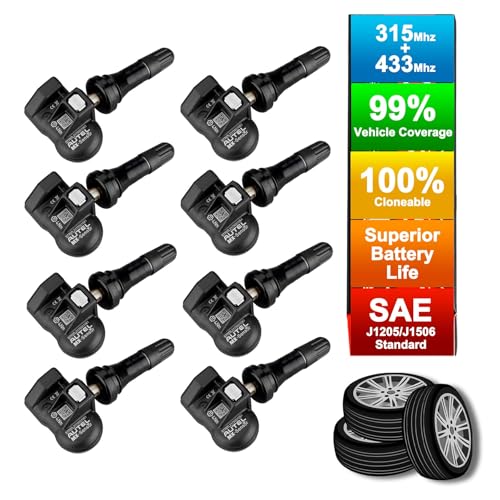
Autel Mx Programmable TPMS Sensor
$109 price checked August 2026
Read our full Autel Mx Sensor review
To understand the various hardware options available, explore the different types of TPMS sensors.

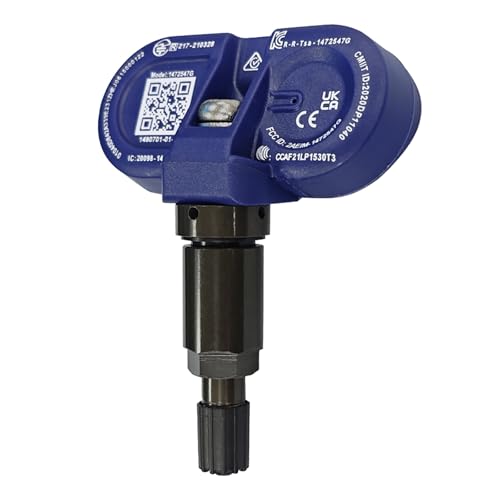
Tesla BLE Bluetooth TPMS Sensor
$114.95 price checked August 2026
For a deeper dive into the underlying technology, learn how tire pressure sensors function internally.
Sensor Types and Signal Quality
- Active Sensors – These units use an internal battery to broadcast a signal to the vehicle’s receiver. Because they are powered, they provide constant monitoring without requiring the wheel to rotate.
- Passive Sensors – These units do not have an internal battery and rely on the rotation of the wheel to generate a signal. These are typically used in systems where the vehicle’s computer “pings” the sensor to get a reading.
- OE (Original Equipment) – This refers to the sensors that came with the vehicle from the factory. These are the benchmark for signal range and battery longevity.
- Aftermarket Sensors – These are third-party sensors designed to replace OE units. High-quality aftermarket sensors aim to match the signal range and reliability of OE hardware while offering different programming options.
- Autel MX-Sensor – This is an industry-standard reference for high-quality, programmable aftermarket sensors. It is frequently used by professional technicians as a baseline for reliable aftermarket performance.
Physical and Environmental Specifications
- IP Rating (e.g., IP67) – This measures the sensor’s resistance to dust and water. A higher first number indicates better dust protection, and a higher second number indicates better water immersion resistance.
- Operating Temperature Range – This is the range of degrees Celsius or Fahrenheit the sensor can function in. You must confirm the low-end limit of the sensor exceeds the coldest temperatures your climate reaches to ensure the battery does not fail in winter.
- Battery Life (Years) – This is the estimated lifespan of the internal power cell. A higher number of years is better, as it reduces the frequency of required tire changes for sensor replacement.
- Valve Stem Diameter – This is the physical width of the sensor’s mounting point. You must confirm the sensor’s diameter matches your vehicle’s valve stem (typically 8mm or 12mm) to ensure a secure, leak-free fit.
- Weight (Grams/Ounces) – This is the mass of the sensor unit. While most sensors are light, you must ensure the weight is within the limits allowed by your vehicle’s wheel assembly.
Commonly Confused Terms
Buyers often confuse frequency with protocol, leading to non-functional installations. A sensor might operate on the correct 433MHz frequency but use a proprietary encoding that the vehicle cannot read. You must verify both the frequency and the compatibility of the encoding before purchasing.
Another common point of confusion is the difference between “programmable” and “cloneable.” A programmable sensor can be taught a new ID by a tool, while a cloneable sensor can be programmed to mimic the exact ID of an existing OE sensor. For many modern vehicles with “locked” systems, a cloneable sensor is the required choice to avoid a programming lockout.
Lastly, “Active” and “Passive” sensors are often confused regarding their power source. An active sensor uses a battery to “push” data out, while a passive sensor is “pulled” by the vehicle’s computer. You must know which system your vehicle uses, as a passive sensor will not work in an active system and vice versa.