There are three primary types of tire pressure sensors that differentiate how a vehicle communicates data to a driver. The core distinction lies in the hardware architecture: whether the sensor is a passive component that requires a separate receiver, a standalone unit that broadcasts to a dashboard, or a complex module that integrates directly into the vehicle’s internal computer systems. Choosing between these depends entirely on whether you are retrofitting an older vehicle, replacing a failed factory component, or seeking a specific level of data granularity.
Direct-Fit Replacement Sensors
Direct-fit replacement sensors are designed to match the exact specifications of the original equipment (OE) hardware installed by the manufacturer. These sensors use the same frequency (such as 315MHz or 433MHz) and the same communication protocol as the factory system. If you are replacing a failed sensor in a modern vehicle, this is the standard requirement to ensure the car’s computer recognizes the new hardware.
These sensors provide the most seamless experience because they do not require additional hardware or complex software configurations. They offer the same functionality as the original parts, providing real-time pressure and temperature readings directly to the dashboard. Because they must match specific manufacturer requirements, they occupy a mid-to-high price band relative to universal options, as the variety of compatible protocols limits the manufacturing scale.
Where these choices show up in our reviews
Prices across these 3 run from $109 to $109; each one has a full review here.

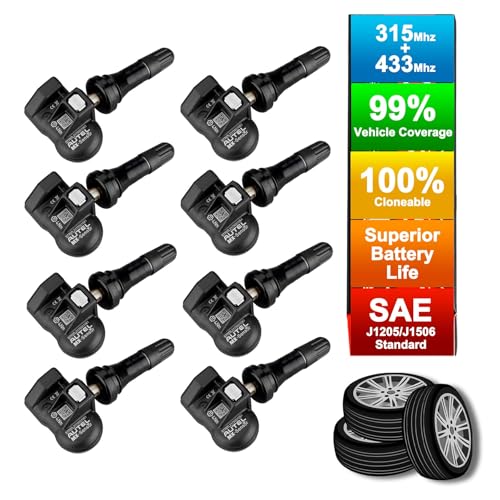
Autel Mx Programmable TPMS Sensor
For a foundational overview, learn how a tire pressure sensor works to understand the underlying technology.
$109 price checked August 2026

Universal Tire Pressure Sensors
Universal tire pressure sensors are independent units that broadcast data to a separate, external receiver, which is then connected to a display or a mobile device. These are the primary choice for owners of older vehicles that were not manufactured with a factory TPMS system. Because they do not need to “talk” to the car’s internal computer, they are not restricted by manufacturer-specific protocols.
You can understand common tire pressure sensor specs if you need to decode technical terminology.
The main advantage of universal sensors is their broad compatibility across almost any vehicle type, including motorcycles and heavy machinery. They offer high flexibility but require the installation of an external hardware component, such as a dashboard display or a Bluetooth gateway. These are generally the most affordable option because they use standardized, high-volume hardware rather than specialized automotive protocols.
External Receiver Systems
External receiver systems refer to the hardware architecture used by universal sensors to collect and display data. In this setup, the sensors transmit a signal—often via Bluetooth Low Energy (BLE) or standard RF—to a hub. This hub processes the raw data and sends it to a screen or a smartphone app.
This type of system is ideal for users who want to monitor multiple vehicles or who prefer a digital interface over a dashboard light. It provides the most data transparency, often showing trends over time or historical logs. The compromise is the reliance on a secondary device; if the receiver loses power or the battery dies, the monitoring capability ceases. These systems sit in a variable price band depending on the quality of the display hardware used.
Comparison of Tire Pressure Sensor Types
| Sensor Type | Best-Fit Buyer | Main Advantage | Main Compromise |
|---|---|---|---|
| Direct-Fit Replacement | Owners of modern vehicles with failed sensors | Seamless integration with factory dashboard | Limited to specific vehicle makes and models |
| Universal Sensors | Owners of older vehicles without factory TPMS | Compatible with almost any vehicle | Requires installation of an external receiver |
| External Receiver Systems | Users wanting mobile alerts or multi-vehicle tracking | Detailed data logging and remote monitoring | Dependent on external power and connectivity |
How to determine which type you need
To determine which type of tire pressure sensor fits your requirements, you must first identify the existing hardware on your vehicle. Check if your dashboard currently displays tire pressure readings or if you have a warning light that remains on after a tire change.
Check for existing factory hardware
If your vehicle already has a TPMS system, you must use a direct-fit replacement sensor. You can identify the required frequency by checking the vehicle’s manufacture year and region; for example, many North American vehicles use 315MHz while many European and Asian models use 433MHz. If the sensor is not “programmable” or “cloneable,” it will not sync with your vehicle’s computer, resulting in a “sensor not found” error.
Identify if you need a retrofit
If your vehicle was not built with a tire pressure monitoring system, you should look for a universal sensor setup. This is the correct choice if you want to add the feature to a vehicle that lacks the internal wiring and computer logic to support factory sensors. You will need to decide if you prefer a hardwired dashboard display or a wireless Bluetooth connection to a smartphone.
Confirming communication protocols
Before ordering, confirm whether your vehicle uses traditional RF frequencies or newer BLE (Bluetooth Low Energy) protocols. Some newer models, specifically certain Tesla models, require BLE-specific hardware. If you purchase a standard RF sensor for a BLE-based system, the vehicle will be unable to decode the signal. A professional technician can often identify the specific protocol required for your vehicle’s VIN.